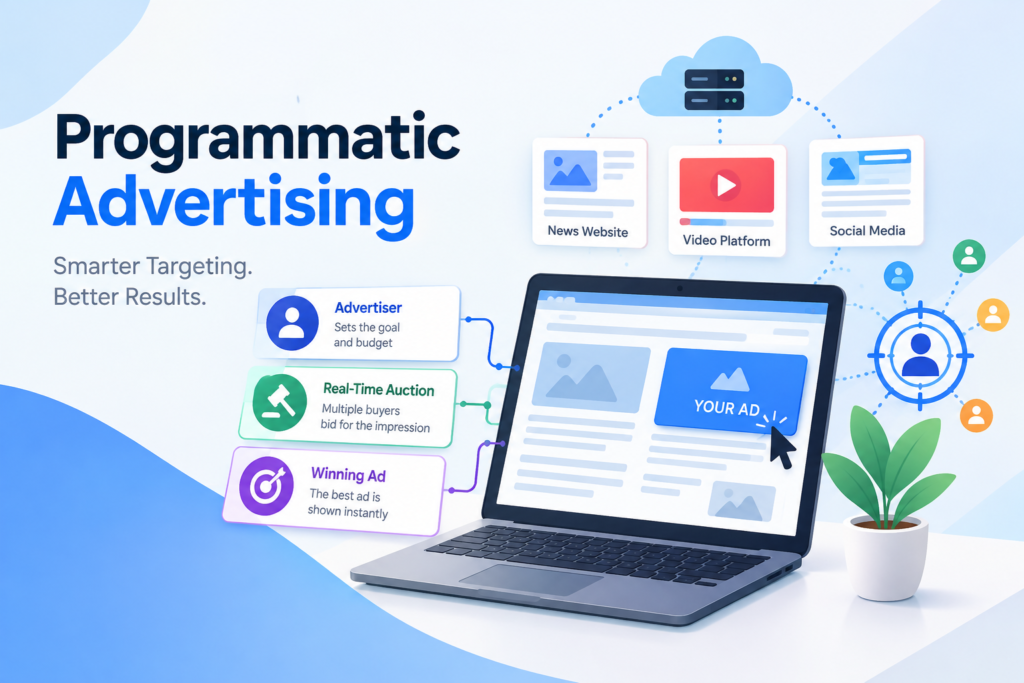
Programmatic advertising is changing the way digital advertising is bought and sold today. Imagine you are looking at a news website. In the time it takes you to read one headline, a complicated auction may already have happened. Multiple advertisers have competed for the chance to show you an ad, an algorithm has selected a winner, and an advertisement suited to that impression has appeared on your screen.
No person had to manually choose the placement. This automated process has become a major part of modern digital marketing.
If terms such as Real-Time Bidding (RTB), Demand-Side Platforms (DSPs), Supply-Side Platforms (SSPs), and ad exchanges sound complicated, do not worry. Understanding the basic process makes the whole system much easier to follow. This article explains what programmatic advertising is, how it works, why it changed the advertising industry, the main types of programmatic buying, its challenges, and where it is heading.
What Is Programmatic Advertising?
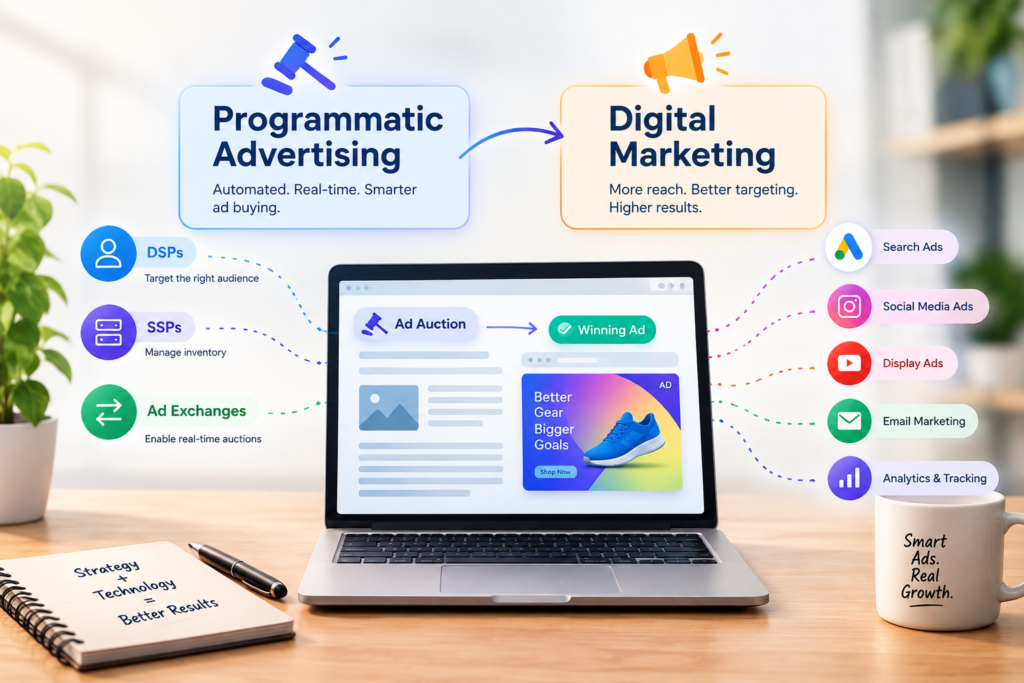
At its core, programmatic advertising is the use of automated technology to buy and sell digital advertising space.
Instead of media buyers and publishers negotiating every placement through emails, phone calls, and insertion orders, software and algorithms can complete many transactions in milliseconds.
A useful way to understand it is to compare advertising with the stock market. Traders can use automated systems to buy and sell shares based on real-time information. In a similar way, advertisers use platforms to compete for individual ad impressions as a webpage, app, or other digital environment becomes available.
This shift has changed how advertisers find audiences, value impressions, allocate budgets, and measure performance.
Cast of Characters: Important Players in the Ecosystem
To understand programmatic advertising, it helps to know the main participants in the ecosystem.
Advertisers
Are businesses or organizations that want to display ads to potential customers. They commonly use a Demand-Side Platform (DSP), software that helps them purchase ad inventory across publishers and ad exchanges while controlling targeting, budgets, bids, and campaign settings.
Publishers
Own websites, apps, or other digital properties where advertising space is available. They can use a Supply-Side Platform (SSP) to manage and sell their available inventory efficiently and seek competitive prices.
Ad exchanges
Provide the digital marketplace where buying and selling can happen. They connect available advertising inventory with advertiser demand and help conduct auctions.
Data Management Platforms (DMPs)
have traditionally helped advertisers organize, analyze, and segment audience information such as demographic characteristics, browsing behavior, and purchase-related signals. As privacy expectations and regulations have evolved, the way audience data is collected and used has also changed.
But How Does It Actually Work? The Amazing Mechanism of Real-Time Bidding
One of the most recognizable parts of programmatic advertising is Real-Time Bidding (RTB), an automated auction that can take place whenever an advertising opportunity becomes available.
Advertisers can also combine programmatic strategies with Google Ads and other paid advertising methods.”, an automated auction that can take place whenever an advertising opportunity becomes available.
Here is a simplified version of what happens:
1. A user visits a website. As the page begins loading, an available advertising slot creates an opportunity for an ad impression.
2. Information about the opportunity is passed into the advertising ecosystem. The ad exchange can receive information about the available placement and relevant, permitted signals about the impression, such as the type of device or contextual information.
3. Advertisers evaluate the opportunity. Through their DSPs, advertisers’ systems determine whether the impression matches their campaign goals and how valuable that opportunity is.
4. Advertisers place bids. Multiple advertisers can submit bids through their platforms, often within an extremely short period.
5. The auction selects a winning bid. The exchange determines the winning opportunity according to the auction’s rules, and the selected creative is delivered for display.
6. The ad appears. By the time the webpage finishes loading, the user may simply see an ordinary advertisement without realizing that an automated buying process has taken place behind the scenes.
Why Programmatic Advertising Disrupted the Industry
Precision
Traditional advertising often involved making broad assumptions about where the right audience might be. Programmatic advertising allows campaigns to use detailed targeting and contextual signals to make impressions more relevant. For example, an advertiser promoting running shoes may want to reach people showing relevant interests or people in a particular location.
Efficiency
Automation reduces much of this repetitive work. Automation lets marketing teams spend more time on strategy and creative work.
Better Allocation of Funds
Programmatic systems can evaluate campaign performance and adjust spending according to defined objectives. If certain audiences, placements, or environments produce stronger results, budgets can be shifted toward them. This makes it possible to use advertising budgets more dynamically instead of treating every placement as equally valuable.
Measurement and Transparency
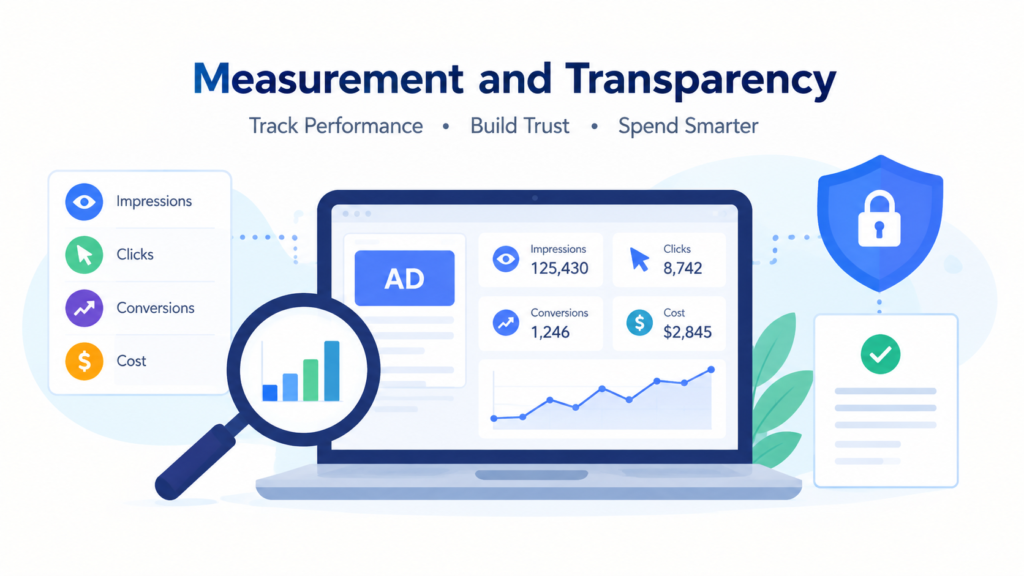
Digital advertising platforms provide measurable information such as impressions, clicks, conversions, and cost-related metrics. These signals help advertisers understand how campaigns are performing and where money is being spent. Digital measurement is far more immediate than traditional media measurement.
Scale
Programmatic advertising allows campaigns to reach audiences across many websites, apps, and digital environments without requiring separate manual negotiations for every publisher. This scalability is one of the main reasons automation has become so important to modern digital advertising.
Programmatic Buying: The Various Types
Not every programmatic transaction works in exactly the same way. Several common approaches are used for different advertising goals.
1. Open Auction (Real-Time Bidding): This is the broad auction-based model in which eligible advertisers can compete for available inventory. It can provide strong reach and efficiency, although advertisers need appropriate controls for quality and brand safety.
2. Private Marketplace (PMP): A PMP is an invitation-based marketplace where selected advertisers receive access to inventory from selected publishers. It can be useful when advertisers want more controlled access to premium placements.
3. Programmatic Guaranteed: In this model, advertisers and publishers agree on pricing and impression volume in advance. There is no traditional open auction for the agreed inventory. It combines automated technology with the predictability of a direct deal.
4. Preferred Deals: A publisher offers selected inventory to an advertiser at an agreed fixed price, but the advertiser is not guaranteed a specific volume. The advertiser generally receives an opportunity to purchase before the inventory becomes available through an auction.
Each model serves a different purpose: open auctions support scale and efficiency, while private and guaranteed arrangements offer more control.
The Challenges Hiding Under the Surface
Programmatic advertising offers major advantages, but automation does not remove every problem.
Ad fraud is one important challenge. Bots and invalid traffic can generate impressions or clicks without genuine human engagement. Verification, fraud-detection, and measurement tools are therefore important for protecting advertising budgets.
Brand safety is another concern. Because ads can be placed automatically across large numbers of digital environments, an advertisement may sometimes appear next to content that does not fit the advertiser’s values. Advertisers need suitable controls, exclusions, and monitoring to reduce this risk.
Privacy has also become increasingly important. Regulations such as GDPR and the wider move away from third-party cookies have changed how audience information can be collected, processed, and activated. These changes encourage more consent-based and privacy-conscious approaches.
Transparency and the complexity of the supply chain can create another problem. With multiple platforms and intermediaries involved, it may be difficult for advertisers to understand every stage through which their advertising spend moves. Better reporting and supply-path analysis can help address this issue.
Where Is Programmatic Advertising Going?
Programmatic advertising continues to evolve as technology and consumer behavior change.
Connected TV (CTV) is another growing area, bringing programmatic advertising into smart TVs and streaming environments.
Artificial intelligence (AI) is also becoming increasingly important. AI and machine-learning systems can analyze large amounts of campaign data, identify patterns, predict performance, and support bidding and optimization decisions. As these systems improve, advertisers can make more informed bidding and optimization decisions.
First-party data is becoming more valuable as businesses build direct customer relationships and collect information through their own channels with appropriate consent.
Conclusion
Conclusion
Programmatic advertising has changed the way digital advertising works by making the process faster, more efficient, and more automated. Instead of relying mainly on manual ad buying, businesses can now use technology to connect with audiences and deliver relevant advertisements across different digital platforms.
As the digital advertising landscape continues to evolve, programmatic advertising is expected to become even more important. New technologies, changing user expectations, and a greater focus on privacy will continue to influence how online advertising is planned and delivered.
For businesses, understanding programmatic advertising can help them make better decisions about their digital marketing strategies and use advertising budgets more effectively. Ultimately, programmatic advertising is not just about automation—it is about using technology to make digital advertising smarter, more relevant, and more effective.